FAQ
Have questions besides these? Email us or ask in the #general channel on Discord.
Do I need to register?
No. Just show up — all supplies are provided. Find the next cleanup.
How can I nominate a cleanup route?
If you know of a block that needs care and attention, email us, message us on Instagram, or send a message on Discord.
Can I earn community service hours?
Yes. We sign school, DOE, and National Honor Society forms on the spot at every cleanup. See community service hours in Brooklyn for how it works.
Whose job is it to clean our neighborhood? Why do you exist?
Sanitation workers collect the trash, recycling, and compost we set out.; they empty corner litter baskets and run the mechanical street sweepers. Picking litter off the sidewalk in front of a building is the property owner’s job, not theirs. (Sometimes they are called to do targeted cleanups of high-litter areas and illegal dumping.) Parks are a separate system: NYC Parks maintains them with its own staff, and its volunteer program, It’s My Park, run with Partnerships for Parks, organizes community cleanups inside parks rather than on the surrounding sidewalks.
Property owners, including businesses, must clean the sidewalk along their building, including tree pits and grass strips, and the gutter out to 18 inches past the curb. Failure to do this can result in fines of up to $300. Business Improvement Districts supplement that duty and do not replace it.
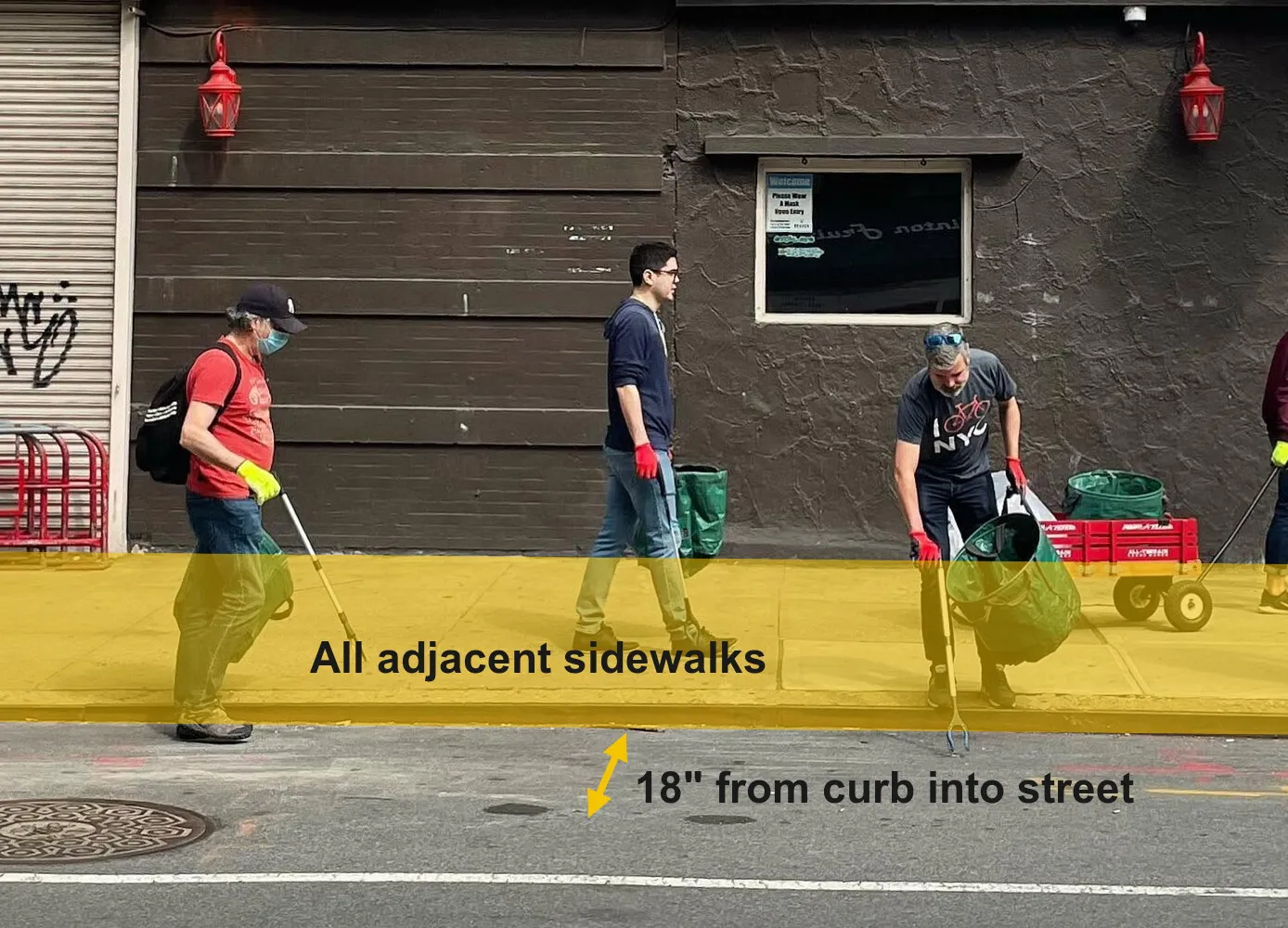
What a property owner must keep clean: the sidewalk, and the gutter out to 18 inches. Photo: Litter Legion
The New York City Department of Sanitation fines dirty sidewalks only during set hours, and those hours differ by property type. Agents ticket dirty sidewalks and gutters only during the specified periods, though they can ticket other violations at any time. Residential enforcement runs 8–9 AM and 6–7 PM, seven days a week. Commercial enforcement is also limited to two one-hour windows a day, and the exact times depend on the address.
Neighborhood groups like ours fill a different role. We bring people together, raise awareness, and some of us tend green spaces. When neighbors see our volunteers cleaning, many remember their own duty. But volunteers can’t substitute for owners and businesses following the rules. DSNY itself says it writes sidewalk summonses every day but can’t keep the city clean alone.
In many neighborhoods, owners aren’t stepping up. Some owners can afford to hire help; renters depend on landlords and businesses that often don’t. Weak fines can make it worse: when a ticket is cheap and rare, paying it costs less than hiring someone. Under the city’s penalty schedule, a dirty sidewalk or failure to clean 18-inches violation carries a fine with a $300 maximum. Supportive council members fund extra cleaning or donate supplies, but community groups, for all their value, don’t solve the litter problem alone.
Why don’t our streets look like Tokyo? One reason is volume. We produce a lot of single-use plastic and a lot of food waste; organic waste (food scraps, food-soiled paper, yard waste) makes up nearly a third of the city’s residential waste stream. Habits like these take generations to change, and change starts with each of us. That’s why part of our work is building awareness of waste reduction. We lead by example when we have the capacity, and building community support for these values is one of our reasons for existing :)
Credits: Trash Talk NYC Summit Attendees, 2026